Publications
My research focuses on Control, Optimisation, and Learning for Autonomy (COLA), with applications in robotics. For a complete list of publications, please refer to my Google Scholar profile or the UCL publications page.
Selected Publications
The following papers highlight recent work and representative contributions in COLA.
2026
-
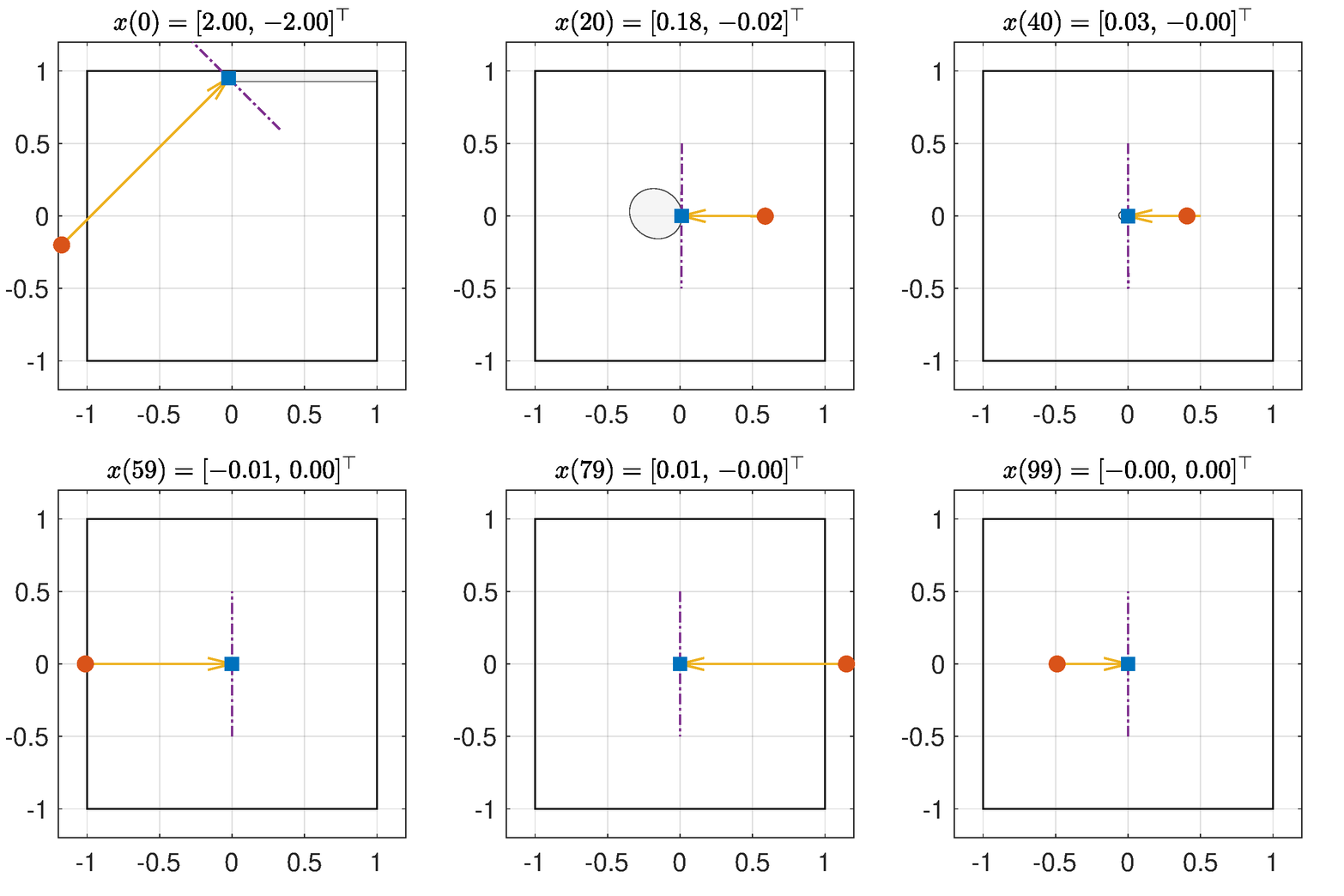 MPC as a Copilot: A Predictive Filter Framework with Safety and Stability GuaranteesYunda Yan, Chenxi Tao, Jinya Su, Cunjia Liu, and Shihua LiarXiv preprint, 2026
Ensuring both safety and stability remains a fundamental challenge in learning-based control, where goal-oriented policies often neglect system constraints and closed-loop state convergence. To address this limitation, this paper introduces the Predictive Safety–Stability Filter (PS2F), a unified predictive filter framework that guarantees constraint satisfaction and asymptotic stability within a single architecture. The PS2F framework comprises two cascaded optimal control problems: a nominal model predictive control (MPC) layer that serves solely as a copilot, implicitly defining a Lyapunov function and generating safety- and stability-certified predicted trajectories, and a secondary filtering layer that adjusts external command to remain within a provably safe and stable region. This cascaded structure enables PS2F to inherit the theoretical guarantees of nominal MPC while accommodating goal-oriented external commands. Rigorous analysis establishes recursive feasibility and asymptotic stability of the closed-loop system without introducing additional conservatism beyond that associated with the nominal MPC. Furthermore, a time-varying parameterisation allows PS2F to transition smoothly between safety-prioritised and stability-oriented operation modes, providing a principled mechanism for balancing exploration and exploitation. The effectiveness of the proposed framework is demonstrated through comparative numerical experiments.
@article{yan2026mpc, title = {MPC as a Copilot: A Predictive Filter Framework with Safety and Stability Guarantees}, author = {Yan, Yunda and Tao, Chenxi and Su, Jinya and Liu, Cunjia and Li, Shihua}, journal = {arXiv preprint}, year = {2026}, } -
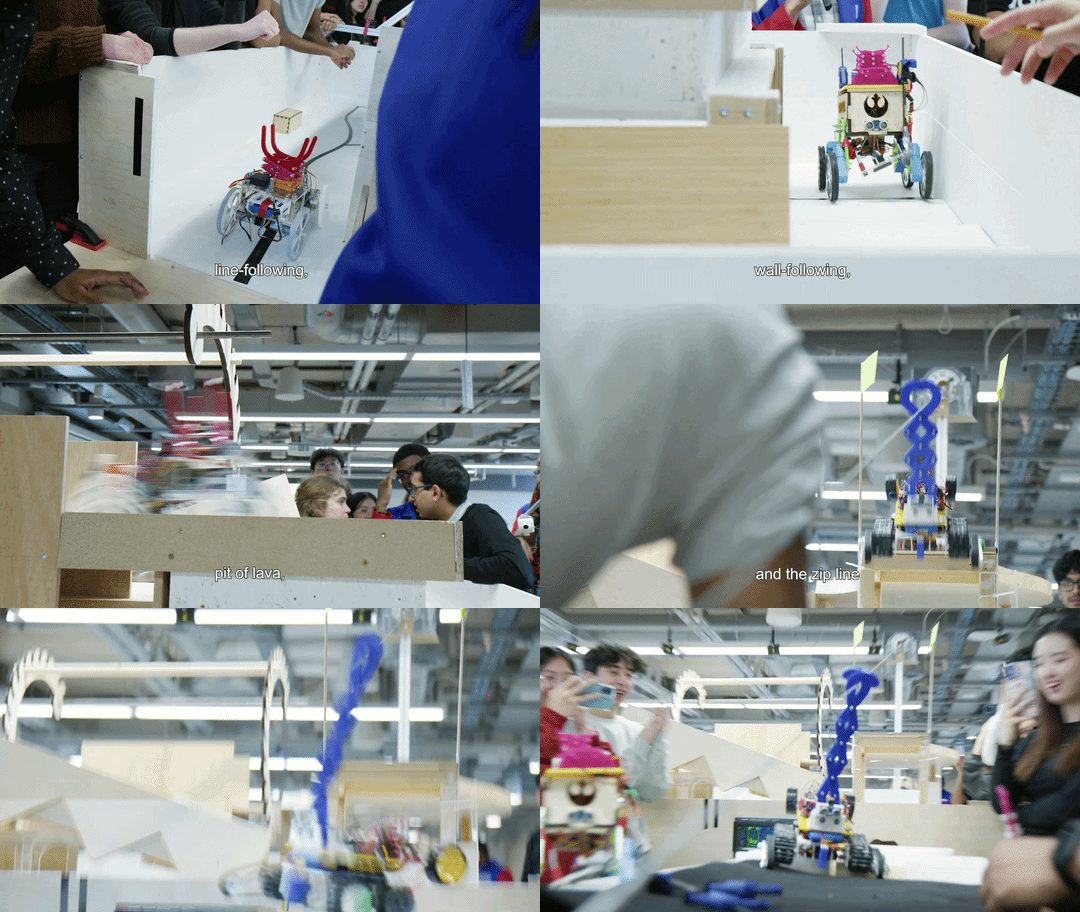 Project-Based Learning for Year 1 Students in the Context of Robotics and Artificial Intelligence: A Robotics ChallengeIgor Gaponov, Oliver Collier, Alex Charitonidis, Daniel Tozadore, and Yunda YanIn the IEEE Global Engineering Education Conference (EDUCON), 2026
The paper provides an overview of a project-based learning (PBL) activity called Robotics Challenge taking place at the end of Year 1 of the MEng Robotics and Artificial Intelligence undergraduate programme at University College London. The aim of this paper is to investigate efficacy of project-based learning activities in a multi-disciplinary context of robotic and AI in a particular laboratory and organisational settings for Year 1 university students. In this paper, we describe organisation, assessment and learning outcomes of the Year 1 Robotics Challenge, study the effects of changes introduced based on student feedback, and investigate their impact on students’ technical and transferrable skills. Student feedback suggests that interventions and changes to activity format led to significant improvements in terms of achieving intended learning outcomes of the event, particularly in the areas of project management, professional development, and team cohesion.
@inproceedings{gaponov2026project,
  title = {Project-Based Learning for Year 1 Students in the Context of Robotics and Artificial Intelligence: A Robotics Challenge},
  author = {Gaponov, Igor and Collier, Oliver and Charitonidis, Alex and Tozadore, Daniel and Yan, Yunda},
  booktitle = {the IEEE Global Engineering Education Conference (EDUCON)},
  year = {2026},
  organization = {IEEE},
}
2025
-
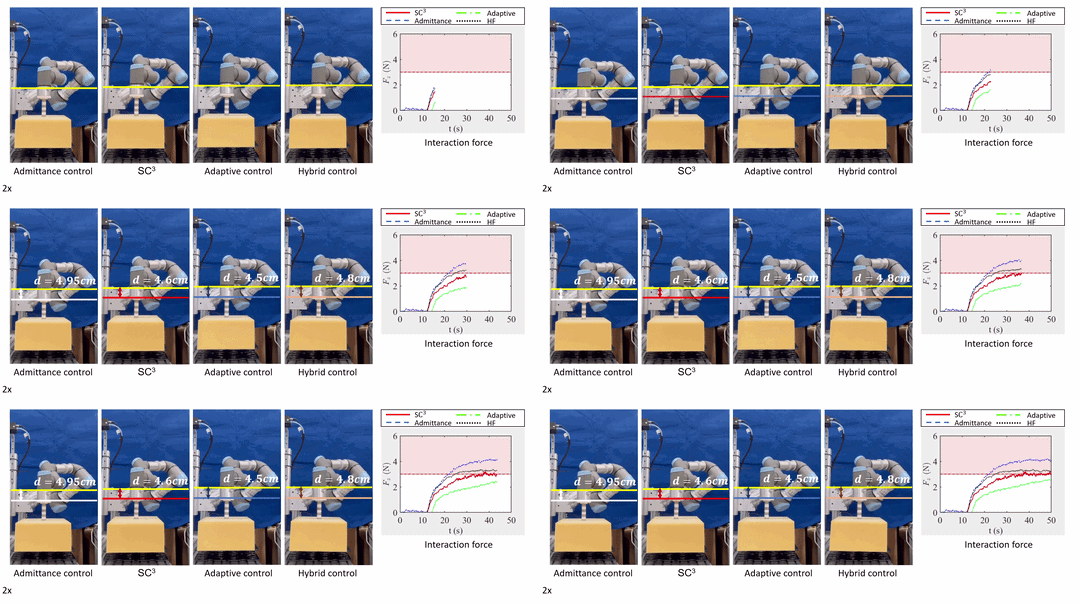 Guarding Force: Safety-Critical Compliant Control for Robot-Environment InteractionXinming Wang, Jun Yang, Jianliang Mao, Shihua Li, and Yunda YanIEEE Robotics and Automation Letters, 2025
In this letter, we propose a safety-critical compliant control strategy designed to strictly enforce interaction force constraints during the physical interaction of robots with environments. The interaction force constraint is interpreted as a new force-constrained control barrier function (FC-CBF) by exploiting the generalized contact model with the prior information of the environment, e.g., the prior stiffness, for robot kinematics. The difference between the real environment and the generalized contact model is approximated by constructing an uncertainty observer, and its estimation error is quantified on the basis of Lyapunov theory. By interpreting strict interaction safety specifications as a dynamic constraint and restricting the desired joint angular velocities in kinematics, the proposed approach modifies nominal compliant controllers using quadratic programming, ensuring adherence to interaction force constraints in partially uncertain environments. The strict force constraint and the stability of the closed-loop system are rigorously analyzed. Experimental tests using a UR3e industrial robot with different environments verify the effectiveness of the proposed method in achieving the force constraints.
@article{wang2025guarding, title = {Guarding Force: Safety-Critical Compliant Control for Robot-Environment Interaction}, author = {Wang, Xinming and Yang, Jun and Mao, Jianliang and Li, Shihua and Yan, Yunda}, journal = {IEEE Robotics and Automation Letters}, volume = {11}, number = {1}, pages = {930--937}, year = {2025}, publisher = {IEEE}, } -
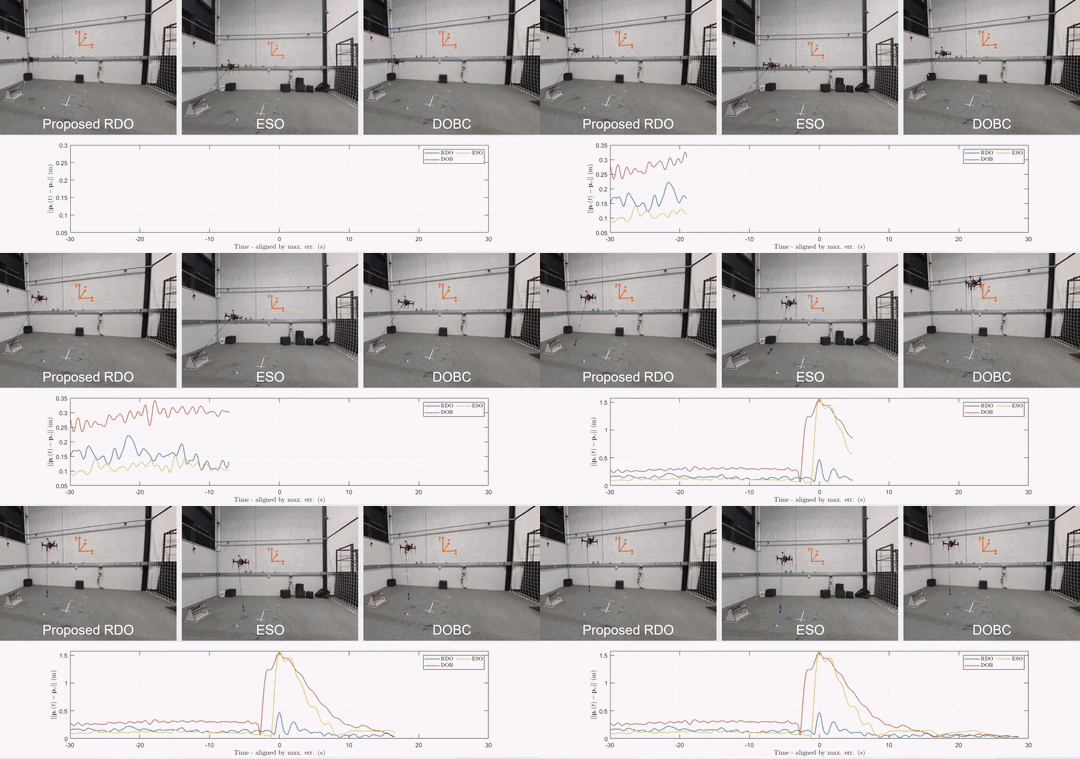 Redundant Observer-Based Tracking Control for Object Extraction Using a Cable Connected UAVBenjamin J Marshall, Yunda Yan, James Knowles, Chenguang Yang, and Cunjia LiuIEEE/ASME Transactions on Mechatronics, 2025
A novel disturbance observer (DOB) based controller is proposed for quadrotors tethered via an elastic cable to improve performance in object extraction tasks. Unlike a typical rigid connection, the elastic cable offers compliance but introduces forces proportional to the quadrotor’s position, creating challenges in accurately estimating and compensating for external disturbances. The proposed method jointly estimates the vertical disturbance and the stiffness coefficient of the cable by leveraging the redundant measurements across all three translational channels. A pseudoinverse technique is used to determine the observer gain functions, such that the estimation of the two quantities is decoupled and stable. Compared to standard DOB, which assume nearly constant disturbances, the proposed approach can quickly adjust its total force estimate as the tethered quadrotor changes its position or tautness of the tether. Two experimental scenarios are conducted: tracking performance under a constant tether strain, and an object extraction task, where the quadrotor manipulates a nonlinear mechanism mimicking the extraction of a wedged object. In both cases, the proposed controller significantly outperforms standard DOB and extended state observer methods in repeated tests.
@article{marshall2025redundant,
  title = {Redundant Observer-Based Tracking Control for Object Extraction Using a Cable Connected UAV},
  author = {Marshall, Benjamin J and Yan, Yunda and Knowles, James and Yang, Chenguang and Liu, Cunjia},
  journal = {IEEE/ASME Transactions on Mechatronics},
  volume = {30},
  number = {6},
  pages = {7638--7648},
  year = {2025},
  publisher = {IEEE},
}
2023
-
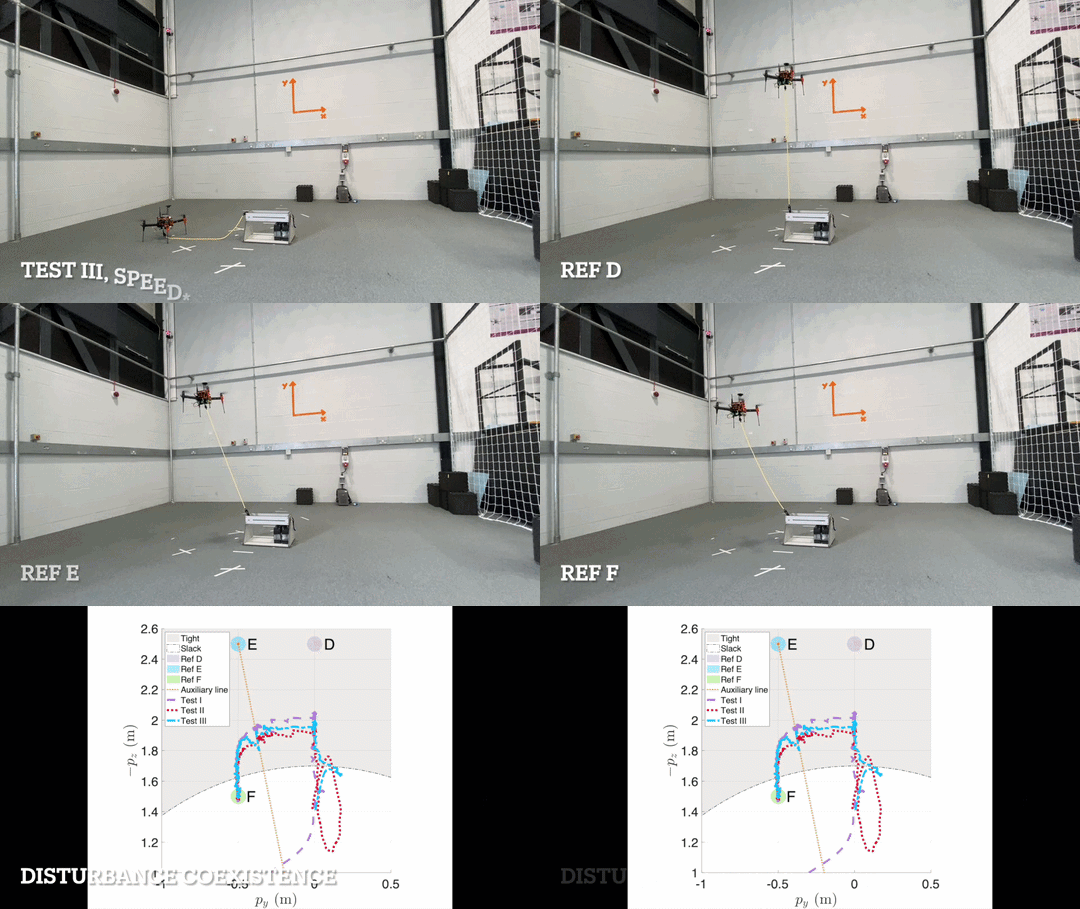 Surviving Disturbances: A Predictive Control Framework With Guaranteed SafetyYunda Yan, Xue-Fang Wang, Benjamin J Marshall, Cunjia Liu, Jun Yang, and Wen-Hua ChenAutomatica, 2023
Rejecting all disturbances is an extravagant hope in safety-critical control systems, hence surviving them where possible is a sensible objective a controller can deliver. In order to build a theoretical framework starting from surviving all disturbances but taking the appropriate opportunity to reject them, a sufficient condition on surviving disturbances is first established by exploring the relation among steady sets of state, input, and disturbance, followed by an output reachability condition on rejecting disturbances. A new robust safety-critical model prediction control (MPC) framework is then developed by embedding the quartet of pseudo steady input, output, state, and disturbance (IOSD) into the optimisation. Unlike most existing tracking MPC setups, a new and unique formulation is adopted by taking the pseudo steady disturbance as an optimisation decision variable, rather than directly driven by the disturbance estimate. This new setup is able to decouple estimation error dynamics, significantly contributing to the guarantee of recursive feasibility, even if the disturbance or its estimate changes rapidly. Moreover, towards optimal coexistence with disturbances, offset-free tracking of a compromised reference can be achieved, if rejecting the disturbance conflicts with safetycritical specifications. Finally, the benefits of the proposed method have been demonstrated by both numerical simulations and experiments on aerial physical interaction.
@article{yan2023surviving,
  title = {Surviving Disturbances: A Predictive Control Framework With Guaranteed Safety},
  author = {Yan, Yunda and Wang, Xue-Fang and Marshall, Benjamin J and Liu, Cunjia and Yang, Jun and Chen, Wen-Hua},
  journal = {Automatica},
  volume = {158},
  pages = {111238},
  year = {2023},
  publisher = {Elsevier},
}
2020
-
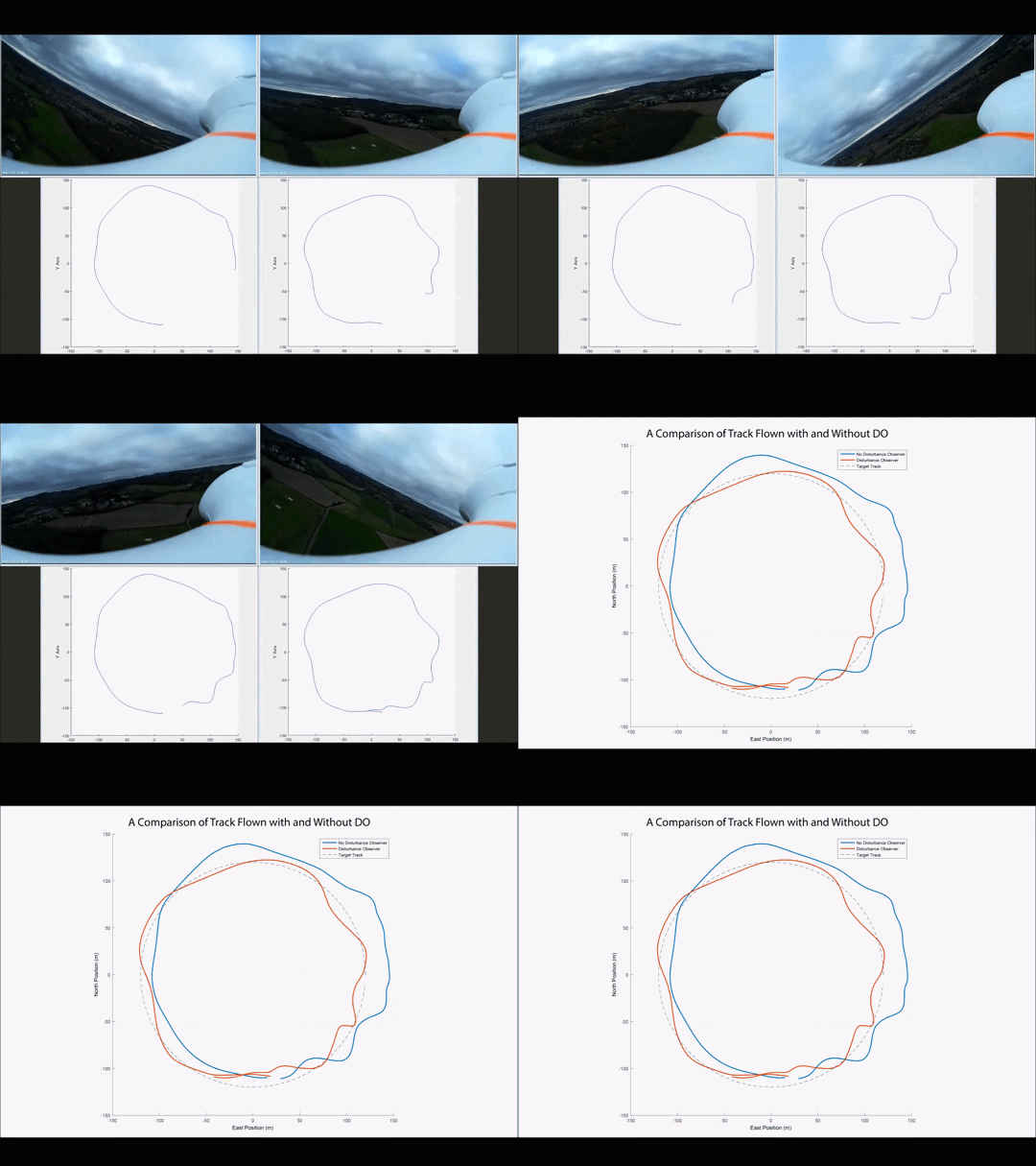 Optimal Path Following for Small Fixed-Wing UAVs Under Wind DisturbancesJun Yang, Cunjia Liu, Matthew Coombes, Yunda Yan, and Wen-Hua ChenIEEE Transactions on Control Systems Technology, 2020
This article presents a novel path-following algorithm for fixed-wing unmanned aerial vehicles by virtue of a nonlinear optimal control approach and wind disturbance observers. Different from some exiting algorithms, the proposed algorithm formulates the path-following problem into a control problem by introducing auxiliary dynamics for the path parameter. The proposed controller is designed in an optimal and systematic manner where the control action is generated according to a well-defined cost function. This framework does not require any complex geometric coordinate transformation and can be easily tuned to accommodate curved reference paths, making it straightforward to deploy in different flight missions. Moreover, the wind influences on the path-following performance is explicitly compensated by the proposed algorithm based on the wind estimates provided by nonlinear disturbance observers. The closed-loop stability, including the auxiliary dynamics for path parameter and observer dynamics for wind estimation, is also analyzed. The feasibility and effectiveness of the proposed algorithm have been thoroughly validated in simulation studies and realistic flight tests.
@article{yang2020optimal, title = {Optimal Path Following for Small Fixed-Wing UAVs Under Wind Disturbances}, author = {Yang, Jun and Liu, Cunjia and Coombes, Matthew and Yan, Yunda and Chen, Wen-Hua}, journal = {IEEE Transactions on Control Systems Technology}, volume = {29}, number = {3}, pages = {996--1008}, year = {2020}, publisher = {IEEE}, } -
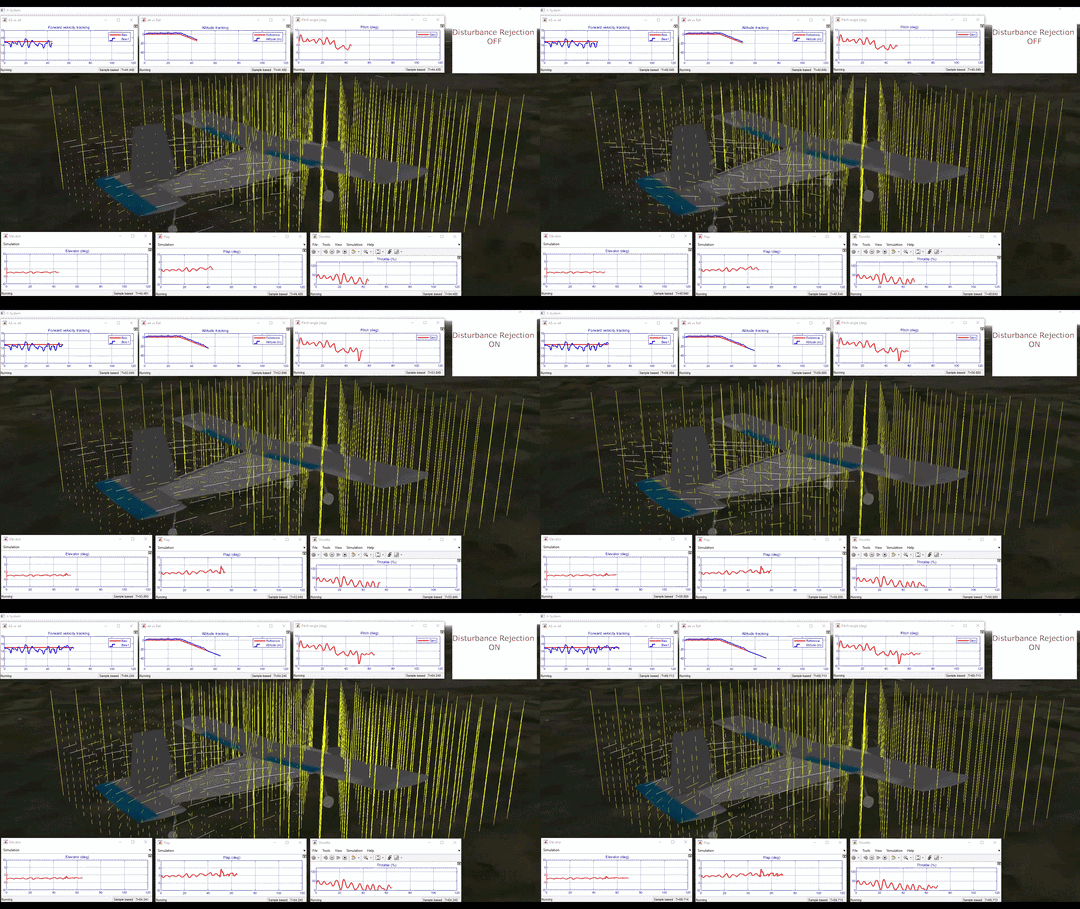 On the Actuator Dynamics of Dynamic Control Allocation for a Small Fixed-Wing UAV With Direct Lift ControlYunda Yan, Jun Yang, Cunjia Liu, Matthew Coombes, Shihua Li, and Wen-Hua ChenIEEE Transactions on Control Systems Technology, 2020
A novel dynamic control allocation method is proposed for a small fixed-wing unmanned aerial vehicle (UAV), whose flaps can be actuated as fast as other control surfaces, offering an extra way of changing the lift directly. The actuator dynamics of this kind of UAVs, which may be sluggish comparing with the UAV dynamics, should also be considered in the control design. To this end, a hierarchical control allocation architecture is developed. A disturbance observer-based high-level tracking controller is first designed to accommodate the lagging effect of the actuators and to compensate the adverse effect of external disturbances. Then, a dynamic control allocator based on a receding-horizon performance index is developed, which forces the actuator state in the low level to follow the optimized reference. Compared with the conventional control allocation method that assumes ideal actuators with infinite bandwidths, higher tracking accuracy of the UAV and better energy efficiency can be achieved by the proposed method. Stability analysis and high-fidelity simulations both demonstrate the effectiveness of the proposed method, which can be deployed on different fixed-wing UAVs with flaps to achieve better performance.
@article{yan2020actuator,
  title = {On the Actuator Dynamics of Dynamic Control Allocation for a Small Fixed-Wing UAV With Direct Lift Control},
  author = {Yan, Yunda and Yang, Jun and Liu, Cunjia and Coombes, Matthew and Li, Shihua and Chen, Wen-Hua},
  journal = {IEEE Transactions on Control Systems Technology},
  volume = {28},
  number = {3},
  pages = {984--991},
  year = {2020},
  publisher = {IEEE},
}